Indonesia’s diverse culture has given birth to a vast selection of agricultural products that can soar far and away to the many corners of the earth if marketed using the right strategy. The concept of Geographical Indication is a brilliant means to deliver Indonesia’s best products to the arms of happy customers around the world, especially to the welcoming European market.
However, despite tireless efforts to familiarize producers and traders with the concept of Geographical Indication, the relevant legal tools to protect and promote this valuable asset is still foreign to many.
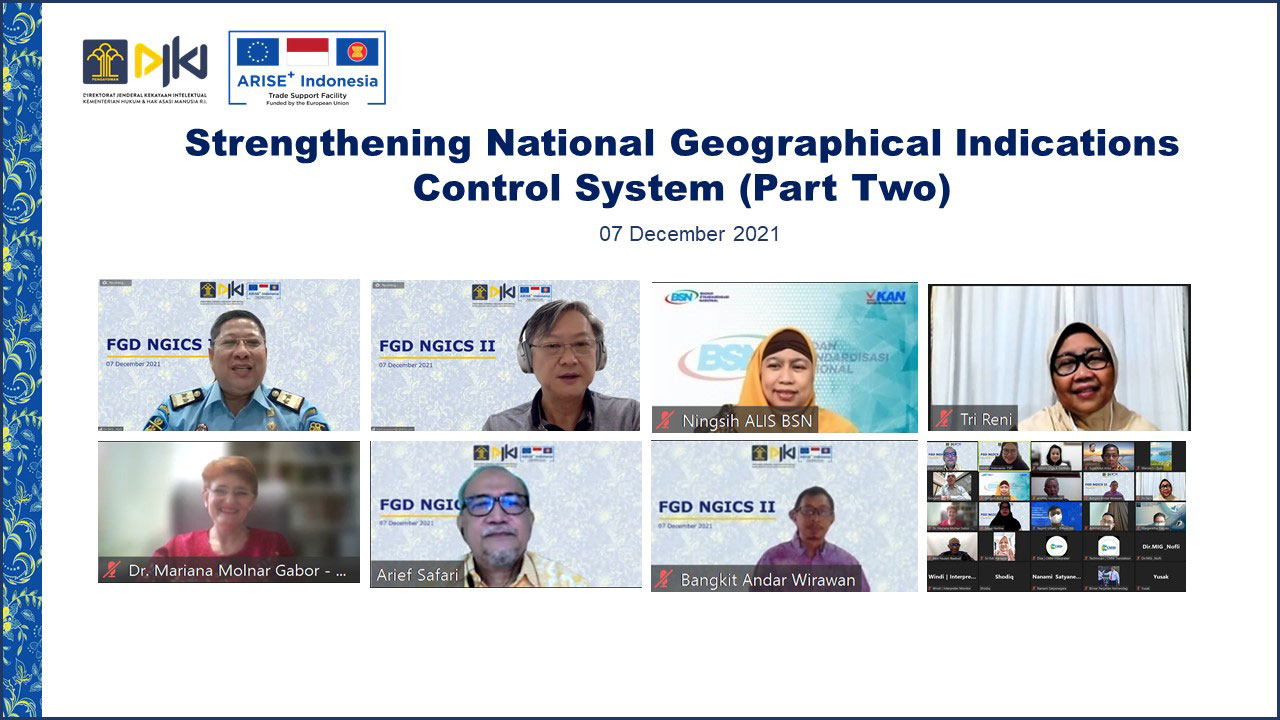
To address the issue, the Directorate General of Intellectual Property under the Ministry of Law and Human Rights, with support from ARISE+ Indonesia, has hosted a string of workshops to find the best control system and scheme to maximize Indonesia’s potential value domestically and on export markets. The first workshop was held on October 29, 2021, and a follow-up workshop was concluded on December 7, 2021.
Director of Trademarks and Geographical Indication of Directorate General of Intellectual Property, Mr Nofli, said that the legal tools to enhance the Geographical Indication among Indonesian producers, farmers, and creators had been developed since 2001.
“As the time passed, there had been 103 Geographical Indications registered in the Directorate General of Intellectual Property. Among them, 94 were from Indonesian producers, and nine are from abroad,” he said in his opening remarks.
“The potential in Indonesia is still huge so that in the future more Geographical Indication will increase. It needs to be accompanied by a good control system, internally by the certificate holder and externally by relevant parties.” Mr Arief Safari and Mr Bangkit Andar Wirawan, experts from ARISE+ Indonesia, facilitated the workshop.
In the workshop, Mr Arief explained that there were six areas with room for improvement in the National Geographical Indication Control System: capacity enhancement of the Ministry of Law and Human Rights, recruitment of Geographical Indication experts from universities, Geographical Indication committee management at provincial level, certification and its enforcement of compliance, building traceability system using blockchain technology, as well as the enforcement of standard that covers reputation, quality, and characteristics. It is imperative that these areas be urgently and adequately addressed so that Indonesian producers may embrace the concept of Geographical Indication properly, and their products can be marketed with a premium value.
The group decided to adopt a Roadmap, to develop a model inspired by the scheme successfully applied by Thailand, whose silk product is registered as a Geographical Indication in the European Union.
Mr Bangkit explained that when adapting this Roadmap, the Directorate General of Intellectual Property should focus on administrative activities, substantive inspection, as well as monitoring. The producers should undertake control internally, while the external control should be enforced by the concerned provincial committee whose members are representatives of the local Law and Human Rights office, the academia, consumer representative, and the Police. Regional administrators should also encourage local producers to get a Geographical Indication certification. As more products get registered, it is imperative to develop a strong system for Indonesian products to be traced, monitored, and inspected.
Currently, experts from Arise+ Indonesia are working on establishing Geographical Indication internal control systems and developing a digital online traceability application for three products.
Presentation Materials