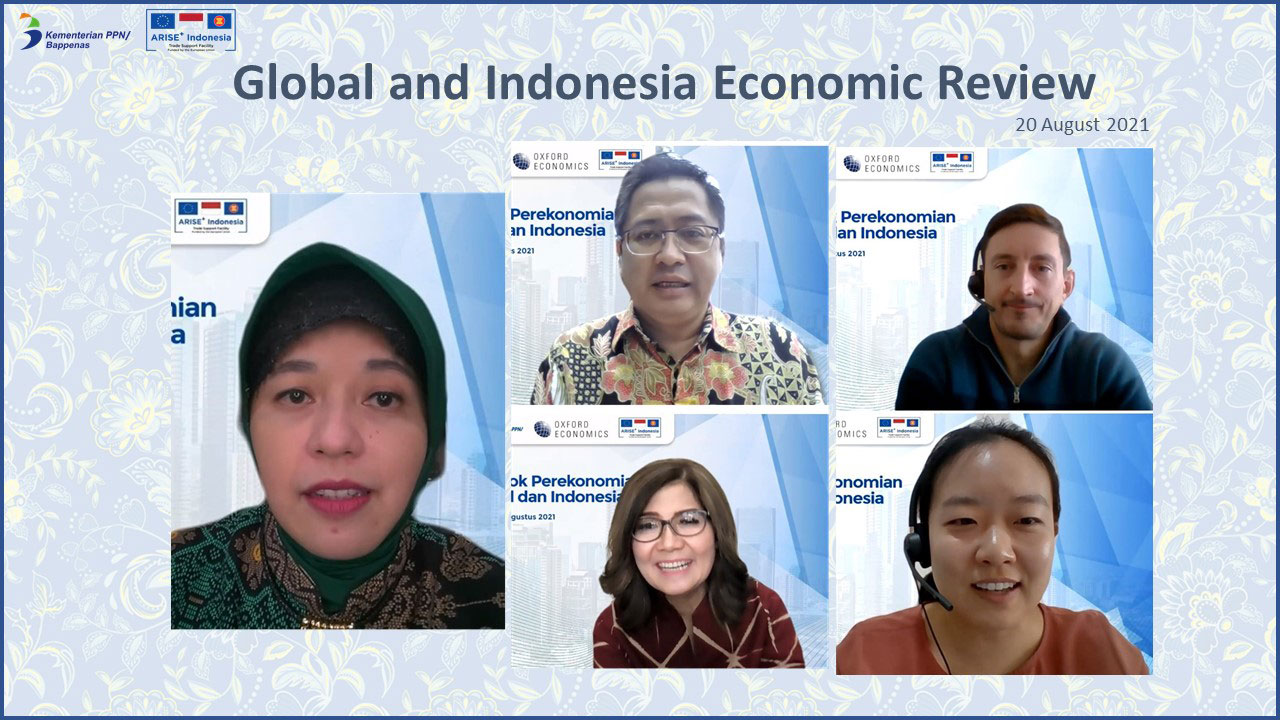
The Government of Indonesia is reviewing its macroeconomic plan to bring the economy back to pre-pandemic performance. With the support of ARISE+ Indonesia, the Directorate of Macro Planning and Statistical Analysis of the Ministry of National Development Planning (Bappenas) organised the Global and Indonesia Economic Outlook Webinar on Friday, August 20 to look at the latest trends analysis and consider policy options.
Deputy Minister for Economic Affairs of Bappenas, Amalia Adininggar Widyasanti, opened the webinar which was attended by more than 700 participants from ministries, including Bappenas, key agencies, local governments, SMEs associations, universities, and research institutions.
"It is imperative to accelerate Indonesia’s economic growth to reach the pre-pandemic COVID-19 level," Ms Adininggar said in her opening remark.
COVID-19 has profoundly impacted global economies and Indonesia is no exception. During the second quarter 2021, BPS recorded that Indonesia’s economy grew at 7.07%, but this achievement was still moderate compared to other countries. Indonesia has to transform its macroeconomic plan to regain its economic growth trajectory to the pre-COVID 19 levels.
"If we cannot do it, I'm worried Indonesia would not be able to escape the middle-income trap before 2045," said Ms Adininggar. She hoped the webinar outcomes could strengthen macroeconomic planning analysis for development planning.
In his introduction, the Director of Macro Planning and Statistical Analysis of Bappenas, Eka Chandra Buana, said that there would be no economic recovery if Covid-19 cannot be contained. Bappenas forecasts Indonesia's economy to grow by 3.5% - 4.3% only in 2021 due to the most recent surge which forced further restrictions.
"If it grows higher, it means we are winning in handling COVID-19," Mr Buana said.
Speaking at the webinar, Tom Rogers and Sung-Eung Jun, of Oxford Economics, presented the global economic outlook and the implication for Indonesia and Asia during the pandemic COVID-19. The webinar also invited Aviliani Malik, the Senior Researcher of the Institute for Development of Economics and Finance (INDEF), to discuss the strategies and policies to achieve Indonesia's 2021 goals.
According to Tom Rogers, although the Delta variant is still on the rise, it has not affected the recovery of major economies, especially the countries with fast and successful vaccine rollout. Some countries are reopening their economies and starting to accept living with COVID-19 rather than eliminating it.
"The impact from Delta to global recovery still looks modest, key trade indicators continuing to recover at the global level," Rogers said.
Consumer confidence continues to strengthen and is becoming a key growth driver, especially in the US, UK, and the eurozone.
In the emerging economies with low vaccination rates, including Indonesia, the manufacturing sector has fallen back into a steep recession.
In the industry sector, capacity constraints are affecting every industrial sector around the world. The cost of moving goods worldwide has increased sharply between two to threefold since the pandemic started. Businesses are responding by scaling up investment as quickly as possible. So business investment has rebounded back much more sharply than it did during the global financial crisis. Inflationary pressures should start to ease because businesses will be able to scale up capacity in the next year or two.
During her presentation on Indonesia's economic outlook, Sung-Eun Jung underlined that Indonesia’s economic performance depended on how successful government efforts are in containing COVID-19.
Private consumption is still a key pillar of Indonesia’s economic growth. It accounts for more than 55% of GDP. Private consumption will be contracted in Q2 and Q3 of 2021 before it rebounds next year after a significant part of the population gets vaccinated.
Net exports have supported growth throughout last year and recovered remarkably well, with total exports 15% above pre-pandemic levels.
Indonesia will experience further delayed recovery to 2022 - 2023. Pent up demands may be released in mid-2022 when higher vaccination rates allow for more sustained economic reopening.
Both fiscal and monetary policies will remain accommodated in the near term. Indonesia's fiscal deficit will narrow to 3%.
According to Sung, COVID-19 still impedes GDP growth globally, especially when the vaccine does not respond to new variants, forcing the world to lockdown again.
Aviliani, a Senior Researcher from INDEF, offers a strategy to strengthen the micro-economy first and not depend on the macro-economy.
The government must prepare short-term adaptive policies given the increasing frequency of crises. The business sectors should also prepare to cope with changing situations.
Tourism is one of the sectors that should be given priority because it has a big multiplayer effect. This strategy must be combined with strict health protocol.
"We have the opportunity to recover economy very soon because people's perception is very easy to convince," Avilia said.