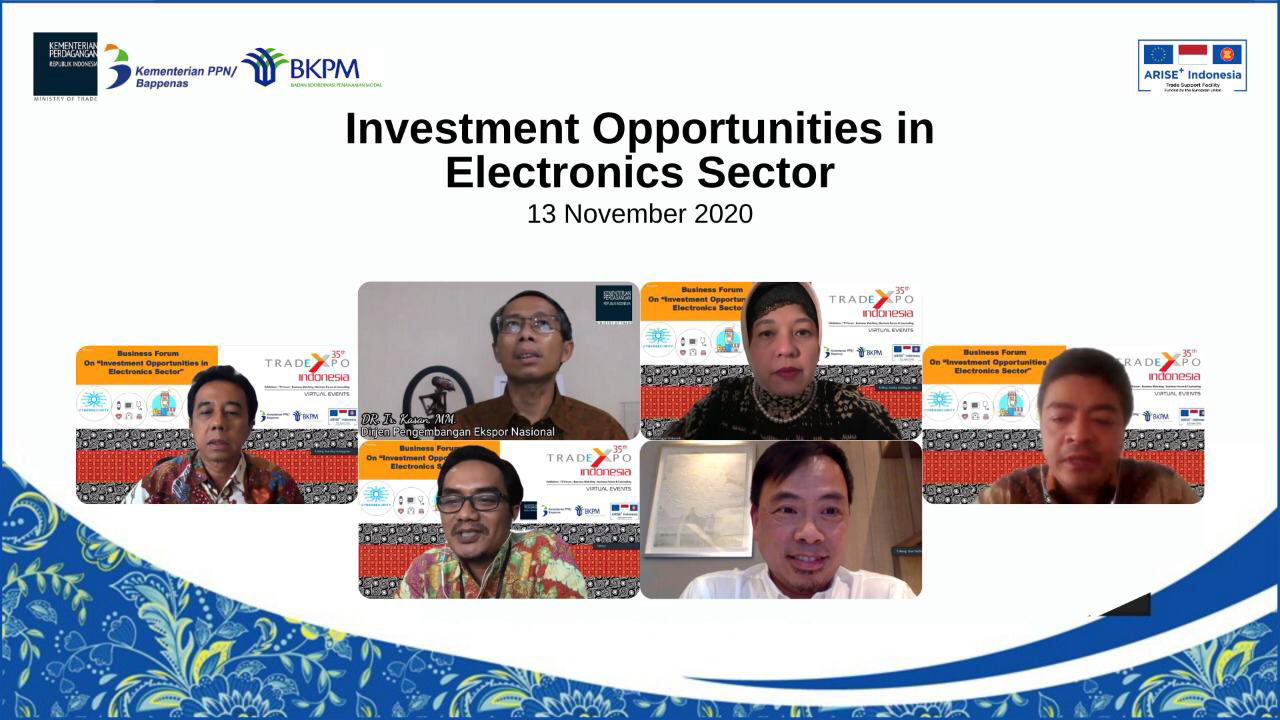
The Ministry of National Development Planning (BAPPENAS), the Directorate General of the National Export Development (DGNED) Ministry of Trade, and the Investment Coordinating Board (BKPM) delivered the result of a study on investment opportunity in electronics sub-sector in Indonesia, on 13 November 2020. The study is entitled “Deep Dive on Investment in Electronics Sector” provides important information for government agencies and electronics business players to explore export opportunity and attract foreign investors to Indonesia.
Electronics has become an important sector in global trade. According to BAPPENAS, world transactions on electronics have continued to grow and reached 3,371 Trillion USD in 2019. Trade on electronics has contributed to around 17 percent on average of total global trade during the past two decades. In the second quarter of 2020, when the trade of most manufactured products contracted, the growth of electronics products grew positively.
The East and South East Asia regions have become the largest producers of 55 percent global electronics (10 years on average). The share of ASEAN countries in global electronics trades is around 14.4 percent and the East Asian countries is 40.5 percent.
“The top 5 biggest electronics players in the region in 2019 are China, Korea, Singapore, Japan and Vietnam. The trade in spare parts and components within the countries in the region is quite large, about 50 percent. However, Indonesia’s participation is still minor, but Indonesia has a lot of potential. Indonesia is located in a very strategic location to be part of a regional production network,”
Amalia Adininggar Widyasanti, Acting Deputy for Economic Affairs, the Ministry of National Development Planning (BAPPENAS).
It is clear that electronics industry has become the main driver of economic growth and employment in various developing countries, including Indonesia. For this reason, the Government of Indonesia has included the electronic sector as one of the main sectors that becomes priority in the “Roadmap for Making Indonesia 4.0.” The strategies of this roadmap include encouraging global investors to do business in Indonesia, improving the quality of human resources, driving innovation and the use of technology. This is expected to reduce the dependence of Indonesia's electronic industry on imported components and increase the added value of local production so that it can dominate the international market.
“The government of Indonesia will continue to strive to encourage increased exports of electronic products and their participation in global value chains. Indonesia's participation in the global value chain will also provide benefits, namely encouraging the growth of the domestic industries as competitors and suppliers, and attracting investors from other countries to do business in Indonesia,”
Dr. Ir. Kasan, MM, Director General of National Export Development, Ministry of Trade, in his keynote speech.
The improvement of the electronics industry in Indonesia will contribute to economic growth, sustain/create jobs, encourage knowledge/technology transfer and potential for domestic linkages, and boosting export. It will also attract many investors because Indonesia has a large market, provides labour and skills that are relatively cheaper compared to other ASEAN countries, has relatively strong capacities in consumer electronics (final goods) and many local inputs (306 SMEs in 2015).
However, several challenges should overcome. Indonesia's export competitiveness in many electronic products is still low. Compared to other ASEAN countries, Indonesia’s participation in the production network in the electronic sectors is relatively low, especially in industrial electronics and electronics components. Investment in the electronics subsector is still relatively small compared to other sectors.
One of the important resolutions of the Government of Indonesia is to prioritise the electronics industry and to become one of focuses of the National Medium-Term Development Plan 2020-2024 by increasing the added-value of employment, investment, expertise and industrialization.
You may access the webinar presentation materials through this link.