Protecting Geographical Indication (GI) products entails strong cooperation between government competent authorities and the private sector, including GI associations, control bodies and accreditation agencies which are important to monitor and conduct market surveillance. Those are the key takeaways from a webinar on legal protection of GI products.
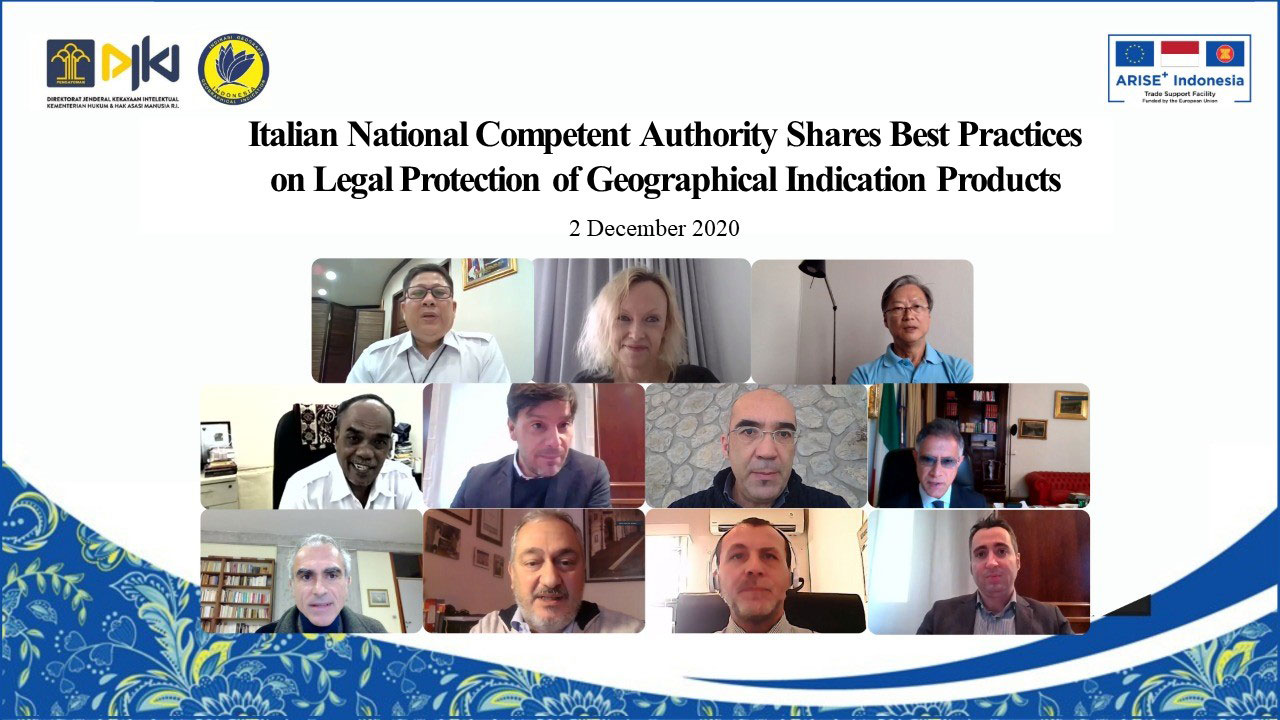
The webinar titled "Control and Protection of GIs Registered Names: Approach and Best Practices from EU" was hosted by the Directorate General of Intellectual Property (DGIP) of the Ministry of Law and Human Rights, with support from ARISE+ Indonesia, on December 2, 2020.
The event benefited from the collaboration of the Italian Embassy to Indonesia. Italy has a long-running history of GI legal environment, and its first relevant law goes back to 1930. Currently, Italy is the European country with the highest number of GI registered food products. The Head of Commercial Section of the Italian Embassy to Indonesia and the Director of ICQRF, the Italian GI national competent authority under the Ministry of Agriculture were among the key-note speakers.
The webinar titled "Control and Protection of GIs Registered Names: Approach and Best Practices from EU" was hosted by the Directorate General of Intellectual Property (DGIP) of the Ministry of Law and Human Rights, with support from ARISE+ Indonesia, on December 2, 2020.
The event benefited from the collaboration of the Italian Embassy to Indonesia. Italy has a long-running history of GI legal environment, and its first relevant law goes back to 1930. Currently, Italy is the European country with the highest number of GI registered food products. The Head of Commercial Section of the Italian Embassy to Indonesia and the Director of ICQRF, the Italian GI national competent authority under the Ministry of Agriculture were among the key-note speakers.
"Protecting GIs is indeed important because it contributes to the welfare of the community,"
Mr Nofli, the Director of Trademarks and Geographical Indications, said in his opening remarks.
The Government of Indonesia is committed to registering, promoting, and protecting Geographical Indication (GI) products in the domestic and international markets.
Currently, 97 GI products are registered in Indonesia (as of September 2020), of which 88 GI products are originating within the country and 9 GI products from abroad. All of the products have been controlled in terms of their reputation, quality and characteristic.
The EU delegation, Head of Trade and Economic Section, Marika Jakas, said that GI matters economically and culturally. It helps create value for local communities through products that deeply rooted in tradition, culture and geography.
Currently, 97 GI products are registered in Indonesia (as of September 2020), of which 88 GI products are originating within the country and 9 GI products from abroad. All of the products have been controlled in terms of their reputation, quality and characteristic.
The EU delegation, Head of Trade and Economic Section, Marika Jakas, said that GI matters economically and culturally. It helps create value for local communities through products that deeply rooted in tradition, culture and geography.
"GIs supports rural development, contribute to job creation, encouraged biodiversity preservation, and contribute to the socio-economic development of any country,"
she said in her opening remark.
A geographical indication (GI) is a distinctive sign used to identify a product whose quality, reputation, or other such characteristics relate to its geographical origin. It is protected by intellectual property rights.
Due to their good reputation and distinctiveness, GIs registered products are exposed to risks of imitation, evocation, usurpation, and other unlawful use of the registered names.
In the EU, fraud represented nine per cent of the value of the GI product market, according to the EUIPO survey in 2016. In the meantime, mapping and assessing the market value of GI frauds in ASEAN is difficult because there is not a single system for GI in the region and the scope of protection varies from country to country.
In this scenario, market surveillance and legal enforcement of GI regulation becomes a key tool for protection. GI control before and after commercialisation of the product serves as a consumer guarantee on the authenticity and quality declared by the GI producers while protecting the rights holder.
Mr Fabrizio Gualtieri and Mr Domenico Vona, representatives from ICQRF, showcased EU best practices on GI market surveillance and legal protection and enforcement with a case study of Italian GI products.
The Italian GI association, Consorzio Aceto Balsamico di Modena, represented by Federico Desimoni, presented their strategy to prevent and fight fraud. He also laid out the collaboration mechanism between GI associations, the control body, and government competent authorities to monitor the market and protect GI registered names.
The webinar also discussed GI registered names from the market perspective, following a presentation delivered by Prof Maurizio Canavari from Alma Mater Studorum, University of Bologna. The GI registration and certification gives the consumer greater guarantees with the highest level of trust, traceability, and the products' authenticity. According to an EU official study, this is reflected in the GI higher sales price with an average of double sales value for similar products without a certification.
Around 50 Indonesian government officials, competent authorities, and GI associations participated in the webinar. The event aims to support the stakeholders in developing a strategy to strengthen GI control and prepare a roadmap to upgrade mechanisms in preventing, locating and persecuting unlawful use of registered GI names.
Registration and protection of GIs is part of the Indonesia - EU Comprehensive Economic Partnership Agreement (CEPA) negotiations. The I-EU CEPA is expected to boost trade operations between Indonesia and the EU.
Due to their good reputation and distinctiveness, GIs registered products are exposed to risks of imitation, evocation, usurpation, and other unlawful use of the registered names.
In the EU, fraud represented nine per cent of the value of the GI product market, according to the EUIPO survey in 2016. In the meantime, mapping and assessing the market value of GI frauds in ASEAN is difficult because there is not a single system for GI in the region and the scope of protection varies from country to country.
In this scenario, market surveillance and legal enforcement of GI regulation becomes a key tool for protection. GI control before and after commercialisation of the product serves as a consumer guarantee on the authenticity and quality declared by the GI producers while protecting the rights holder.
Mr Fabrizio Gualtieri and Mr Domenico Vona, representatives from ICQRF, showcased EU best practices on GI market surveillance and legal protection and enforcement with a case study of Italian GI products.
The Italian GI association, Consorzio Aceto Balsamico di Modena, represented by Federico Desimoni, presented their strategy to prevent and fight fraud. He also laid out the collaboration mechanism between GI associations, the control body, and government competent authorities to monitor the market and protect GI registered names.
The webinar also discussed GI registered names from the market perspective, following a presentation delivered by Prof Maurizio Canavari from Alma Mater Studorum, University of Bologna. The GI registration and certification gives the consumer greater guarantees with the highest level of trust, traceability, and the products' authenticity. According to an EU official study, this is reflected in the GI higher sales price with an average of double sales value for similar products without a certification.
Around 50 Indonesian government officials, competent authorities, and GI associations participated in the webinar. The event aims to support the stakeholders in developing a strategy to strengthen GI control and prepare a roadmap to upgrade mechanisms in preventing, locating and persecuting unlawful use of registered GI names.
Registration and protection of GIs is part of the Indonesia - EU Comprehensive Economic Partnership Agreement (CEPA) negotiations. The I-EU CEPA is expected to boost trade operations between Indonesia and the EU.