The Indonesia - European Union Comprehensive Economic Partnership Agreement (I-EU CEPA) will support the Indonesian economic transformation and raise living standards. By improving trade access to the EU market, I-EU CEPA has a great potential to improve Indonesia's products and services diversification and competitiveness. The cooperation will also promote investment, facilitate Indonesia's participation in the Global Value Chain and help accelerate the regulatory framework reforms.
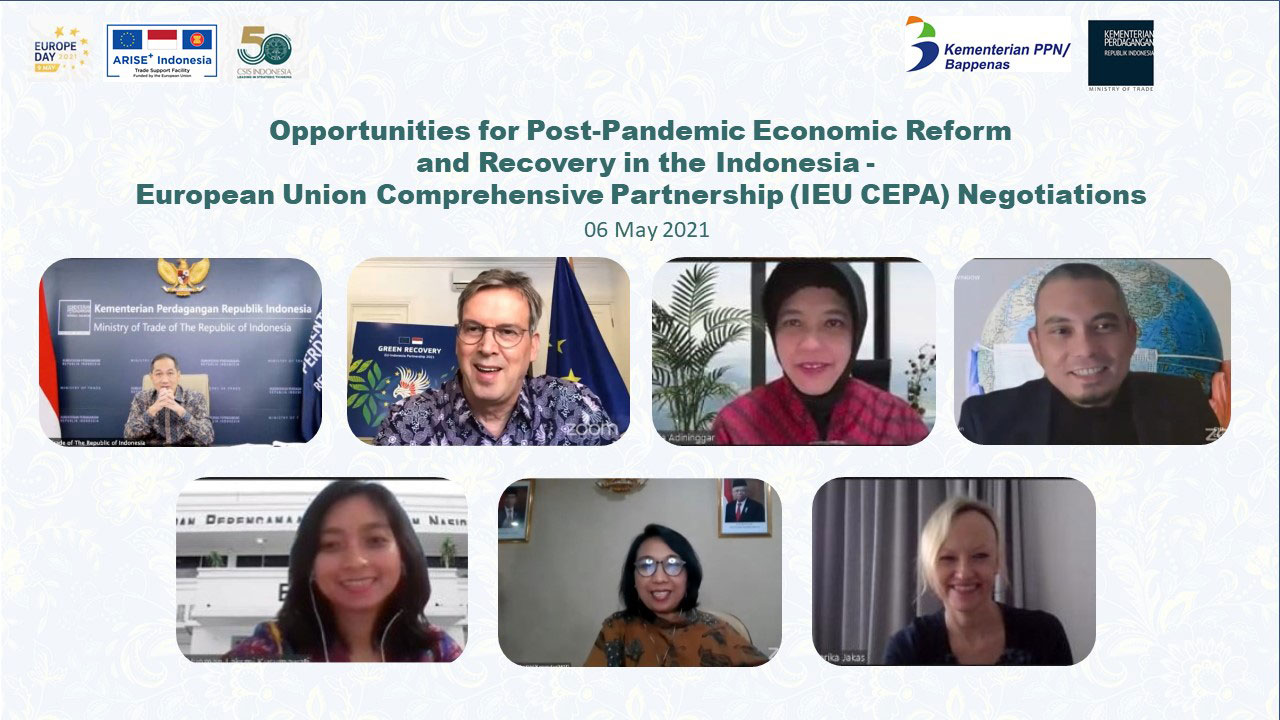
The Centre for Strategic and International Studies (CSIS) presented those key findings of a study on the Indonesia - EU CEPA titled "Seizing Gains from a Transformative Agreement" during a webinar on May 6, 2021.
The EU-funded ARISE+ Indonesia, under the auspices of Bappenas (Ministry of National Development Planning), commissioned the CSIS to assess the impact of the I-EU CEPA on Indonesian trade, economy and social indicators. The study has been developed in close consultation with the Ministry of Trade, several other ministries, government agencies and private sector organisations.
The Minister of Trade, H.E. Muhammad Lutfi, delivered his keynote speech on the importance of the EU market for the Indonesian economy. The Minister of Trade later tweeted, "The I-EU CEPA not only has the potential to increase market access for Indonesian goods and services in the EU but also has the potential to contribute to economic recovery efforts after the Covid-19 pandemic".
The I-EU CEPA will also have a positive impact on the European economy, as stated by the EU Ambassador to Indonesia and Brunei Darussalam, H.E. Vincent Piket, during his opening remarks.
Both the EU Ambassador and the Minister of Trade expressed the desire to restart negotiations after the partial standstill in the past year due to the pandemic, with the intention to conclude the agreement by the end of this year.
Dandy Rafitrandi, the Senior Researcher of CSIS, presented the study results followed by a well-participated panel discussion moderated by Fajar B Hirawan, the Senior Researcher of CSIS. The panellists comprised high-level public officials and private sector representatives, namely:
- the Director of Trade, Investment and International Cooperation of Bappenas, PN Laksmi Kusumawati;
- the Director of Bilateral Negotiations of the Ministry of Trade, Ni Made Ayu Marthini;
- The Head of Trade and Economic Affairs of the EU Delegation to Indonesia and Brunei Darussalam, Marika Jakas;
- the Special Advisor for Industry and International Trade of Ministry of Finance, Kiki Verico;
- the Deputy Chairman of Indonesian Chamber of Commerce and Industry, Shinta Kamdani;
- and the Vice Chairman of EuroCham in Indonesia, Wichard von Harrach.
The panellists are optimistic that the I-EU CEPA will benefit both Indonesian and European economies in the long run.
During closing remarks, The Deputy for Economic Affairs of Bappenas, Amalia Adininggar Widyasanti, reiterated that the I-EU CEPA could be one of Indonesia's post-pandemic economic reform and recovery drivers.
Yose Rizal Damuri, the CSIS's Head of Economics Department, concluded the webinar by thanking the Bappenas, the Ministry of Trade, and the EU for their tremendous support during the development of the study.
The webinar was open for the public and broadcasted live through Zoom and the CSIS Indonesia YouTube channel.