
Export is expected to be the prime mover of Indonesia's economic recovery and transformation. However, accelerating export also comes with the risk of trade remedies investigations initiated by trading partners against Indonesian export.
Trade remedies are trade policy tools that allow governments to take exceptional measures to the World Trade Organization (WTO) basic principles by exerting remedial actions against imports, causing material injury to a domestic industry. These tools consist of anti-dumping, anti-subsidy, and safeguard measures.
In order to ensure the market access of Indonesian export, the Directorate of Trade Defence (DPP) of the Directorate General of Foreign Trade, the Ministry of Trade has the duty to defend the Indonesian exporters from trade remedies allegations by third countries.
On the other hand, KADI (Indonesian Anti-Dumping Committee) has the task of investigating unfair trade when imported goods have a lower price than the domestic price (suspected of containing dumping and subsidies) and cause injury to the domestic industry. Meanwhile, KPPI (Indonesian Trade Safeguard Committee) has the duty to investigate the surge of unforeseen increased imports that cause serious harm to the domestic industry.
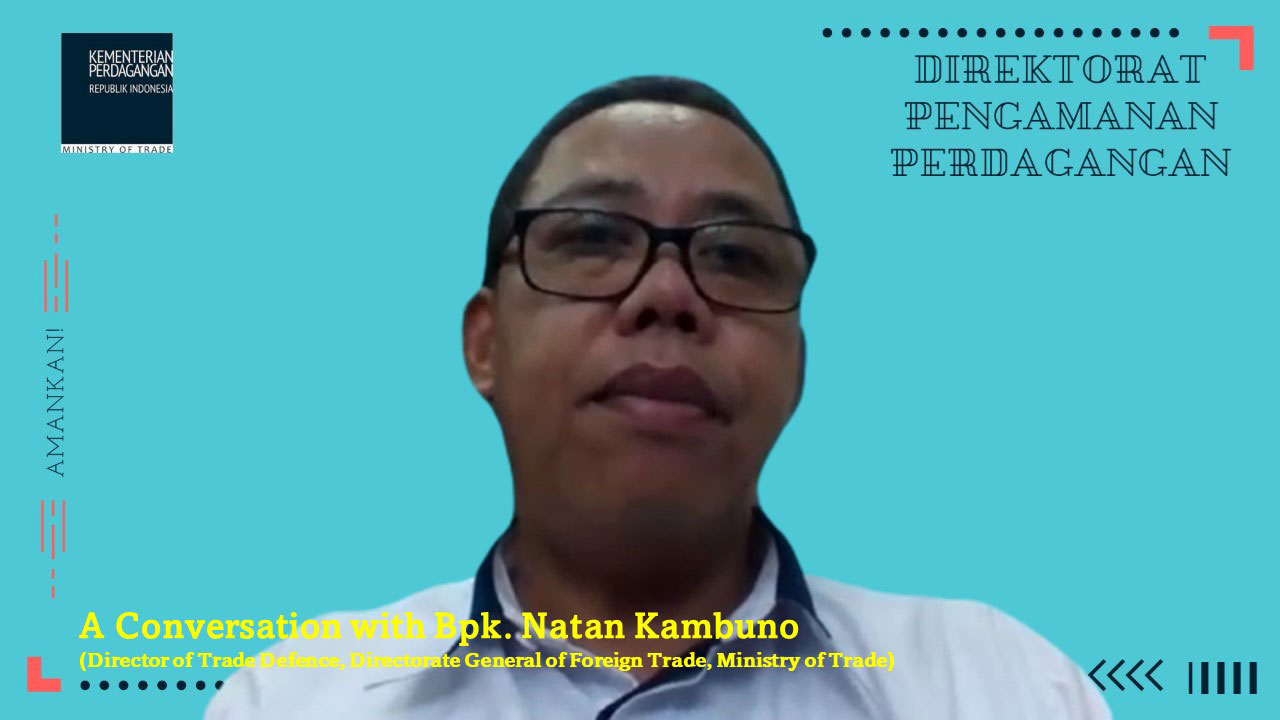
On Monday afternoon (22/11), we had the privilege to interview the newly appointed Director of Trade Defence, Mr Natan Kambuno. He kindly shared his insights in handling trade remedies cases to defend Indonesian exports.
Q: What is the status of the trade remedies cases initiated against Indonesia in 2021?
A: The number of global trade remedies initiation continued to rise despite the COVID 19 pandemic since early 2020. WTO statistics recorded 437 international trade remedies initiations in 2020, increasing more than 50% compared to 2019. Anti-dumping remained the most frequently used instrument globally. In fact, according to WTO statistics, the total anti-dumping initiations against Indonesia has tripled in 2020. It was six cases in 2019 and rose significantly to 18 cases in 2020. As of October 2021, the DPP is dealing with 38 ongoing trade remedies cases that consist of twenty anti-dumping, ten safeguards, seven anti-subsidies and one anti-circumvention. From that number, 26 cases were newly initiated in 2021, while the remaining 12 cases were initiated in 2019 and 2020.
Q: In your view, what would be the causes of increased trade remedies cases during the pandemic?
All countries in the world are doing their best to protect their domestic industry from unfair trade practices such as dumping and subsidies or to cope with a sudden surge import of foreign goods, especially during the pandemic when the global industry has been severely impacted Thus, trade remedies as legal instrument of WTO has been increasingly used by the member countries.
Q: Can you disclose the results of trade remedies cases against Indonesia?
From 1995-2021, we've handled 404 cases coming from 34 countries. Those cases comprised 261 anti-dumping, 35 anti-subsidy, 107 safeguards, and 1 anti-circumvention case. The results were 162 cases being imposed, 204 cases being terminated, and 38 still ongoing cases. Being imposed means the importing country impose anti-dumping duties on the imported product. Being terminated means the case is closed without any duties being imposed. So, mostly we won the cases.
Q: Despite Indonesia's winning, are there any challenges Indonesia faces in trade remedies investigations as a respondent? And what would be the challenges?
Yes, we face some challenges. Trade remedies investigations against Indonesia's exported products came from various countries with different levels of expertise in doing the investigations. Developed countries usually are more advanced in using their trade remedies instruments. EU, for example, has an alternative method to calculate dumped imports if the economy of the exporting country is significantly distorted due to the government's interference. Australia has also been using Particular Market Situation (PMS) as justification to disregard actual sales data in the domestic market of an exporting country, including Indonesia. The use of these instruments will result in very high additional duties to the imported products. Therefore, both the Government of Indonesia and the alleged exporters have to fully cooperate during the investigation process to ensure that the investigating authority calculates the amount of duty according to the WTO requirements.
Furthermore, some issues in trade remedy investigations are still in a grey area, meaning it is not regulated under the WTO Agreements, such as anti-circumvention. Yet, many WTO Members such as the United States and European Union have used this anti-circumvention mechanism to ensure the effectiveness of trade remedy measures. Not only advanced countries, but developing countries, like Turkey, have applied circumvention duties to some Indonesian products also. Even our ASEAN neighbour, Vietnam, just launched an anti-circumvention action on cane sugar against us last August. Therefore, there is an urgent need for both government officials and private sectors to learn more on this issue so that Indonesia can better defend itself from anti-circumvention investigations initiated by other countries.
Another challenge is the requirement to use the local language at all stages during the investigation process, from the initiation document, questionnaires, oral hearings, written submissions, and preliminary and final determination. This requirement, for example, is implemented in Turkey, Taiwan, Vietnam, Thailand, and Madagascar. Close coordination with the representative of Indonesia in foreign countries is therefore essential to ensure that all relevant documents are properly translated. Good time management is also critical since we must translate all the documents prior to submission and still meet the deadline.
As I stated above, the rising trade remedies cases initiations will inevitably result in additional duties applied. The problem is that some countries prolong the duties for an extended period with a sunset review mechanism. Both developed countries, like the US, and developing countries, like Turkey, have applied anti-dumping duties in a range of 10 to 20 years. This situation requires more resources and efforts from DPP to handle the cases in the future.
Q: With those challenges, what would be the strategies to strengthen Indonesia's trade defence policies to protect Indonesian exporters from partner countries' unfair trade practices?
Our strategy is to handle the case immediately after the trade remedies authority has initiated the case, for example, an anti-circumvention case recently initiated by Vietnam. Even before the Vietnam authority issued the case documents, we had already started communicating with our embassy and trade attaché in Hanoi to monitor the case. We were being proactive. After receiving the documents, we immediately coordinated and worked together with all the relevant ministries and the related associations and companies to submit the data and information before the deadline to ensure they are taken into consideration by the investigating authority. DPP also works closely with Indonesia's representatives in foreign countries to get information about economic and other relevant factors that influence the Petitioner's performance. Such data and information are vital for injury submission. Indonesia representatives also play an important role in the communication with investigation authorities, such as delivering the government submission, especially for non-English user countries and the hearing process. If the final determination of the case does not comply with the WTO law and has a detrimental effect on Indonesia's export, the Government of Indonesia may bring such a decision to a WTO dispute panels, like the case of Australia's anti-dumping on Indonesian paper, which we won.
Another important strategy is to strengthen our capacity in handling the cases. Trade remedies issues keep evolving. Therefore, the relevant government officials and private sectors (associations and companies) need to keep updated with the recent development in global trade remedies investigation. It includes the modification of national legislation on trade remedies in other countries and the development of legal interpretation on specific trade remedies issues in the Dispute Settlement Body WTO.
Q: How can ARISE+ Indonesia assist in facilitating these strategies?
ARISE+ Indonesia has assisted both the Government of Indonesia and the private sector in acquiring a better understanding of some particular areas in trade remedies investigation such as Particular Market Situation, Anti-Circumvention, Dispute Settlement in Safeguards, and Less Than Adequate Remuneration in Countervailing Investigations. Training on dealing with trade remedies investigations initiated against Indonesia, by authorities in key export markets such as India, Turkey, and Australia, have also been held. Next year, we will get the opportunity to learn more about European Union and the United States trade remedies system.
With the technical assistance facilitated by ARISE+ Indonesia, we are now better equipped to defend Indonesia's interests in every trade remedy investigation initiated by our trading partners. The support is also beneficial to our colleagues in KADI (Indonesia Anti-Dumping Committee), KPPI (Indonesia Trade Safeguard Committee), and TREDA in the offence side to deliver proper and robust investigations. Especially for KADI, which has a plan to initiate its first anti-subsidy/countervailing investigation.
Q: You just assumed your duty as the Director of Trade Defence. What would be your priorities in strengthening Indonesia's capacities in trade remedies during your leadership?
A quote says that "the best minute you spend is the one you invest in people".
I believe that strengthening the capacity of DPP's employees and other government agencies and private sectors through various training and other activities supported by the ARISE+ Indonesia is the key for the best defence against various trade remedies investigations by Indonesia's trading partners.
DPP is also continuously organizing various events such as focus group discussions and dissemination, inviting other relevant ministries, private sectors, law firms, and universities to discuss Indonesia's position in certain cases. Good communication between the government and relevant stakeholders will give the best result in the case determination. Besides, close coordination with local and international lawyers, including Advisory Centre on WTO Law (ACWL), is also important for sharing knowledge and formulating Indonesia’s defence strategies.
Q: What would be your messages for Indonesian exporters if they have to face a trade remedies investigation?
Trade remedies are the rights of all countries to investigate imports that enter their country to protect their domestic industry, and it's already regulated in the WTO. Doing international trade is not as easy as we think, but we must not be discouraged and keep exporting and improving our export quality. It's a tough competition, including competing with the domestic industry in the importing countries. As long as Indonesia is willing to continue to export, allegations of trade remedies will always be a risk, but we don't have to worry about that.
If we have to face a trade remedy lawsuit, the most important thing for the alleged company is to be cooperative and submit all the data and information required by the investigating authority on time. Being cooperative will benefit the company and be the key to winning the case.