
2022 will be a crucial year for Indonesia to accelerate its economic recovery and growth to achieve its medium-long term development target to becoming a high-income country before 2045. Investment, exports, and the processing industries are expected to drive economic growth. Export of goods and services is expected to grow by 4.3%-6.8%.
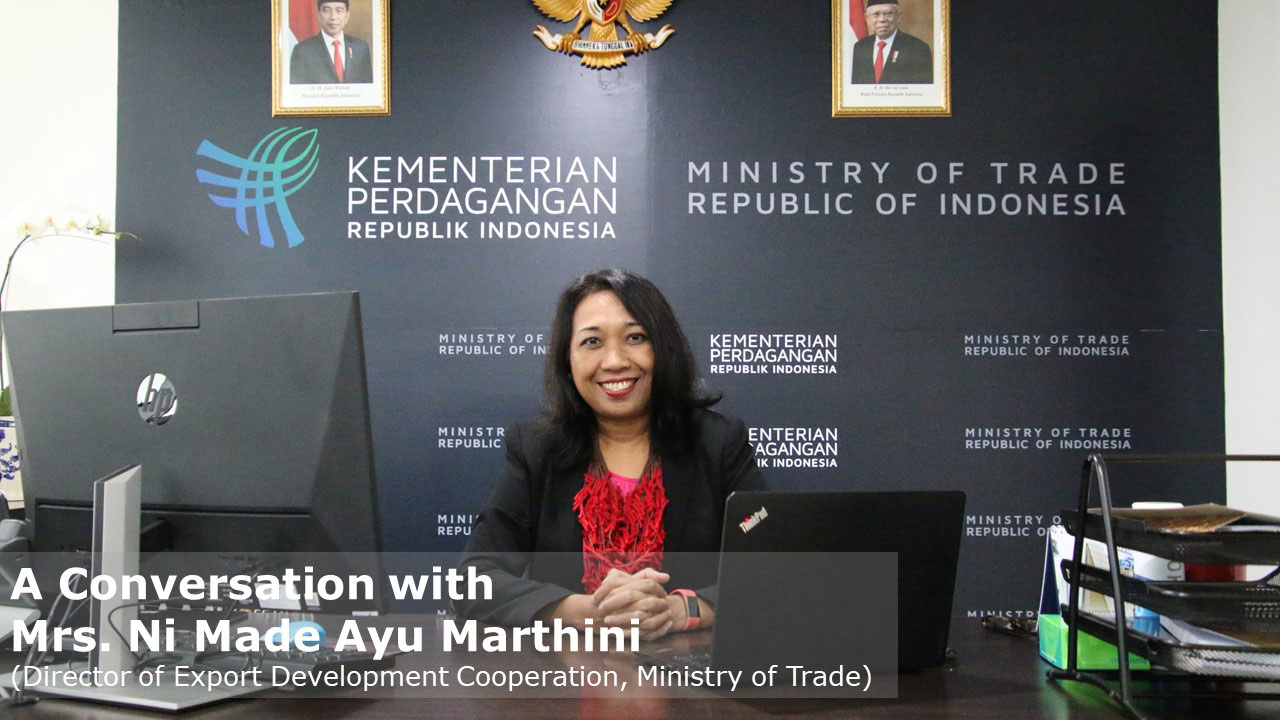
We had the honour to speak with the new Director of Export Development Cooperation under the Directorate-General of National Export Development of the Ministry of Trade, Mrs Ni Made Ayu Marthini, about the strategies to develop national exports.
The following is an excerpt of the interview.
Q: The Government aims to increase export and participation in the Global Value Chains (GVCs) to boost economic growth. What would be DGNED's strategic policies to achieve these objectives?
A: Our strategy has always been diversification of products and markets. We cannot depend on one market as disruptions may happen, and are actually happening now. For instance trade wars and the Russia-Ukraine war disrupt the global supply chain. Thus, Indonesia proactively negotiates new FTAs with various countries worldwide to open new markets.
In addition to market and product diversification, Indonesia is also shifting its export products from raw commodities or primary goods to manufactured goods that give more added value to boost high and steady economic growth. So instead of exporting frozen tuna, we could export processed tuna in a can, which would provide a higher price. Unfortunately, we face tariff escalation for processed products. Thus, we need to negotiate FTAs to get preferential tariffs, for example, from the EU. Negotiating FTAs is critical in levelling the playing field and establishing a fair trade structure. Through the I-EU CEPA, we aim to encourage more economic cooperation and investment to allow technology transfer to strengthen our downstream production and improve our participation in the GVCs.
DGNED promotes partnerships that generate higher value, win-win, and inclusive growth. These are essential principles. There shouldn't be a gap in trade relations because it will not be sustainable and pose risks and issues of fairness.
Q: How should Small and Medium Enterprises (SMEs) prepare themselves to improve their export readiness and competitiveness?
A: First, the SMEs should understand their position to devise export strategies -whether a startup, small, or medium- and understand the market and their readiness to export. Are they ready to comply with standards and certification requirements? SME exporters usually face the main challenges of ensuring product acceptance in the destination market, including product quality and supply consistency. Standardisation and certification requirements, especially for the EU, are quite complicated, even exceeding the international standards. Most of the standardisation and certification requirements in the EU are driven by private bodies or consumers. There are called Voluntary Standards and are more challenging to negotiate. So, if you want to be an exporter, you have to prepare yourself in terms of financial, standards compliance, certification, logistics and shipping, and so on.
SMEs should develop a roadmap or action plan to prepare themselves to export and improve their competence and competitiveness. For example, what they will achieve in the next five years, including certification, market penetration, etc. For startups, they must pay attention to product quality, design, packaging, and promotion storytelling to attract buyers.
Adopting digitalisation is also critical for SMEs to seize the enormous opportunities offered by information technology. SMEs can promote their products and connect with their buyers worldwide through a digital platform. Participation in trade fairs is essential, but now so is using the digital platform.
E-commerce could also be one of the solutions to overcome logistics constraints because the platform company provides shipment services. Building and leveraging networks are also crucial for marketing, finding information about financing, capacity building programs, assistance programs, etc. We have trade attaché representatives in 46 cities around the world that can facilitate export information. But as I said before, the SMEs should be ready to fulfil export requirements first. The Government, including DGNED, can play a role in facilitating such compliance and standards.
Last but not least, it is important for them to participate in training activities to upgrade knowledge, skills, competence and keep abreast of new trends. DGNED offers many training programs that MSMEs can utilise. Other line ministries also have similar MSMEs development programs, such as the Ministry of Cooperatives and MSMEs, the Ministry of Industry, the Ministry of Tourism and Creative Economy, etc.
Q: What can you tell us about Indonesia's participation in the last Dubai Expo? What are the key takeaways and lessons learned in relation to Indonesia's market strategy and the promotion of Indonesian GIs?
A: Indonesia's successful participation in Expo 2020 Dubai has resulted in potential orders of USD 2 billion originating from business forums and business matching activities. Business and investment cooperation agreements worth USD 32.7 billion in business to business (B2B) and Government to Government (G2G) schemes were also signed. During the trade mission, we also signed USD 180 million for gold jewellery products for one year, an MoU for construction projects in the United Arab Emirates (UAE), and the marketing of Indonesian palm oil products in the Middle East region. Not only that, Middle Eastern investors and other countries are also interested in Nusantara Capital City (IKN) projects, Special Economic Zone development and infrastructure, renewable energy, agriculture, education and culture, as well as communication and information technology, which attract many investment opportunities. To help the small industries and SMEs, especially related to Indonesian halal products, we have a business agreement with a leading hypermarket in UAE, which also can be used to promote Indonesian Geographical Indication products in the Middle East market.
Successful participation in international promotional trade fairs requires advance planning and excellent preparation. This is crucial to achieving the intended objectives. Again, before participating in international expos, MSMEs should ensure their export readiness, research whether the products are suitable for the targeted market, and prepare well-crafted promotions. For example, why do we have to buy a GI-certified Koerintji Cinnamon and not just buy regular cinnamon? This is where narrative and storytelling in the promotion play an important role. That proper promotion and story will justify the higher price, as GI-certified products should gain at least 30% higher than regular products. Story and narrative on GIs could also be used to attract tourists. We see a potential to develop a creative program to promote Geographical Indications as a product and tourism destination.
We also learned that the product curation should be conducted thoroughly internally, then by local experts in Dubai to ensure that the products match the market taste.
Another important lesson is the importance of conducting business forums and business matching and inviting the right audiences to our events, whether importers, retailers, the Horeca (hotel, restaurant, and café) industry, etc. Then, follow-ups should be done afterwards.
Q: Geographical Indications are covered by the I-EU CEPA negotiations, among many other areas. What should MPIGs do to obtain the maximum advantage from the agreement as soon as it is fully in place? What kind of support can the Government (DGNED) provide?
A: MPIGs need to have confidence in their products. Having the GI certification means having leverage. MPIGs should guarantee their products' quality, authenticity, and traceability, as stated in the Book of Specification. GI products should also be appropriately branded and attractively packaged to build awareness and reputation using the proper GI label. As I mentioned earlier, the GI products should also be promoted using an engaging narrative and storytelling. When the branding is successful, consumers will look for Alor Vanilla, for example, because they perceive in their mind that the excellent vanilla is from Alor Island in East Nusa Tenggara. In addition to branding, enforcement, which will be supported by colleagues at the Directorate-General of Intellectual Property (DGIP) of the Ministry of Law and Human Rights, is also very important to maintain the reputation of GI products, ensuring that these products have the quality and authenticity as stated in the Book of Specifications.
DGNED is adamant about promoting, educating and putting Indonesian GI products in their right place to be appreciated by the global market. As of now, the Government of Indonesia has registered 72 Indonesian GI products to the European Commission to be covered in the I-EU CEPA, and there will be more in the future.
DGNED also offers development and assistance programs that MPIGs can utilise to improve their competitiveness, including export product and design clinics, facilitation of Hazard Analysis and Critical Control Points (HACCP), Good Manufacturing Practice (GMP), Halal and Organic certification, and education and training programs for Indonesian exports.
Q: What are the challenges that exporting SMEs face in expanding their markets through cross-border e-commerce platforms, and what would be the Government's strategic policies to support exporting SMEs in overcoming these challenges? Are there any special considerations for women-owned businesses?
A: Based on our recent study on e-Commerce, in collaboration with ARISE+ Indonesia, the challenges SMEs face include: high shipping costs, lack of marketing skills, high registration fees for registration on cross-border e-Marketplaces, lack of information about potential buyers, and export development needs (such as knowledge, training) related to e-Commerce.
The Government will take immediate action to address the above challenges by focusing on increasing MSMEs' readiness for e-Commerce in six main development areas, including enterprise-level online marketing and online presence, inventory management, payment and management of foreign exchange rate risk, logistics and distribution, return policy (especially for overseas orders), customer feedback management, and market analysis.
DGNED always promotes gender equality in business activities. In collaboration with development partners, DGNED develops programs that give special preference to women-owned businesses or enterprises where most workers are women.
Q: Obtaining export information is one of the challenges SMEs face. What are the DGNED strategies to address this issue?
A: Providing export information is actually the task and duty of the Directorate of Market Development and Export Information (Dit. P2IE) under the DGNED.
For your information, the Ministry of Trade c.q Dit. P2IE just launched a one-stop service platform for non-oil and gas export facilitation InaExport (inaexport.id), on April 11, 2022. The web-based platform was developed to connect and promote Indonesian business actors or exporters to international buyers.
InaExport aims to help SMEs with sales and develop SMEs to be ready to face the global market. Furthermore, the Indonesian exporters will also receive information on training and trade fairs. In addition, exporters also have an excellent opportunity to be registered and found easily by potential buyers worldwide.
The advantages for buyers include easy access to product catalogues from verified Indonesian suppliers and sending inquiries or purchase requests with just one click. The InaExport system has recorded 11,650 verified suppliers, 6,121 products, 534 market information, 27 activities, and 48 international representatives. This figure is expected to continue to grow.
Q: What can you tell us about the activities with ARISE+ Indonesia that are in the pipeline? What would be the expected results from these activities?
A: We have several planned activities in collaboration with ARISE+ Indonesia. First, collaboration to improve the quality and the promotion of Indonesia's export commodities, especially the GI products. We hope that Indonesian GIs can be accepted and second, building on the success of the e-commerce study last year, we have requested ARISE+ Indonesia to support the identification of e-marketplaces for Muslim fashion and Halal products. Third, a mini-study on the growing sector of Muslim fashion. Fourth, a benchmarking assessment of Indonesia's Trade Promotion Institution. The activity will engage the Geneva-based International Trade Center (ITC) in July 2022. The assessment will provide recommendations to inform the restructuring process to ensure the effective implementation of DGNED duties and functions in promoting Indonesia's products and services to the global market.
Q: How do you see the collaboration with the ARISE+ Indonesia programme in supporting the development of national exports? What would be your expectations from this collaboration?
A: All collaboration activities between ARISE+ Indonesia and ministries/agencies, including DGNED, aim to improve Indonesia's trade performance and export competitiveness. We hope that the technical assistance program will strengthen the capacity of both government officials and SMEs as business and export actors. The ARISE+ Indonesia program is expected to bridge the capacity gap between Indonesia and the EU. Therefore, when the I-EU CEPA agreement is signed, Indonesian businesses can take fully advantage of it, which will improve the welfare of the Indonesian people and support Indonesia's endeavour to achieve Vision 2045.