
Strengthening MSMEs is prioritised in the Job Creation Law No. 11 of 2020 and implemented through Government Regulation No. 7 of 2021 concerning Ease, Protection and Empowerment of Cooperative and Micro, Small, and Medium-sized Enterprises (MSMEs), as part of the Government efforts to realise Indonesia's Vision 2045 in becoming a high-income country and escape the Middle Income Trap. In the wake of the pandemic, strengthening the MSMEs became more priority to boost economic recovery.
Bappenas and the Ministry for Cooperative and MSME are jointly working on Major Project on Integrated MSMEs Development, a programme consisting in designing and piloting a new approach to develop MSMEs.
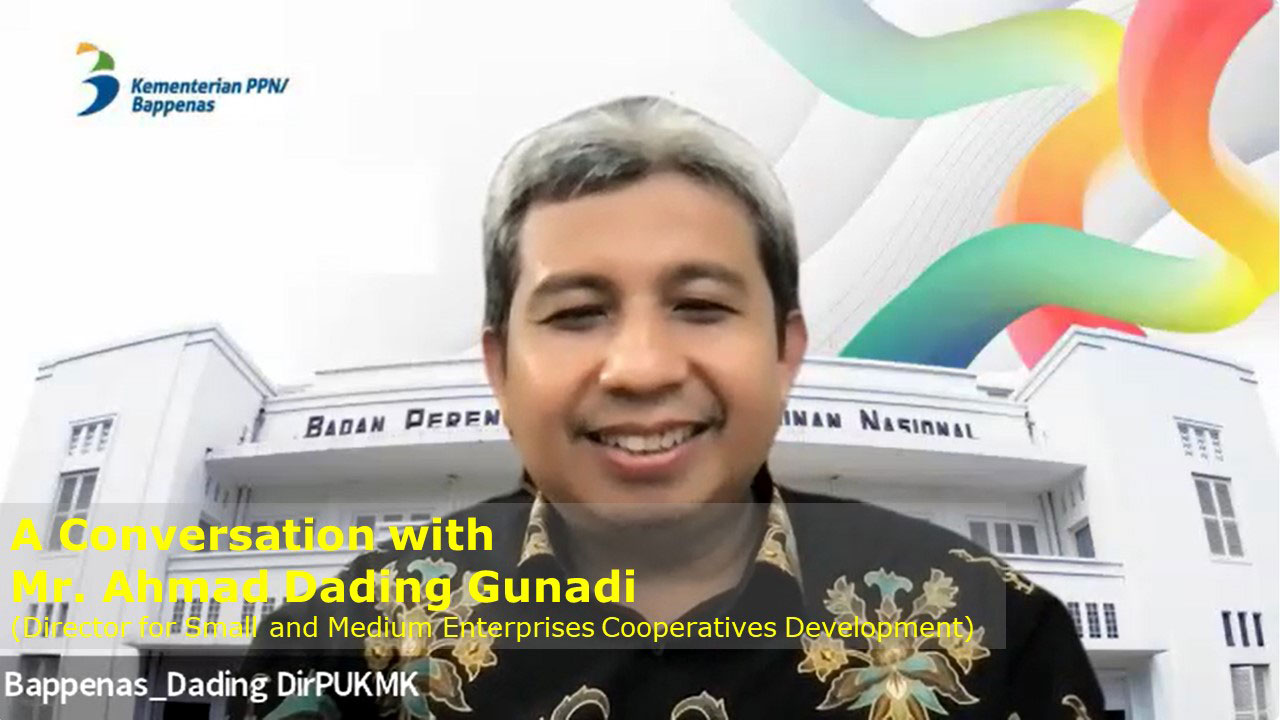
We had the honour to speak with the Director of MSME and Cooperative Development, Bappenas, Dr Ahmad Gunadi Dading, M.A., regarding the development programme.
The following is an excerpt of the interview.
Q: What do MSMEs mean for the Indonesian economy? What would be the vision for future Indonesian MSMEs?
A: MSMEs have a vital role in our economy, accounting for 61,97% of the current national GDP (data 2021). It decreased slightly during the Covid-19 pandemic, but it got back up again quickly. MSMEs have proven to be quite resilient in overcoming various adversities. The pandemic has indeed made them collapse, but many of them have taken the initiative to adapt and change their business models in order to survive, for example, by switching their business online.
Today, MSMEs accounted for 96,9% of all existing business units. So, it is for sure that if we strengthen MSMEs, our economic structure will get more robust because MSMEs absorb more than 90% of the workforce.
From those data, we can see the importance of MSMEs in supporting our economy and the potential for contributing even more to our GDP. Considering the strategic role of MSMEs in our economy, we must empower entrepreneurs and continue to strengthen MSMEs and spur their growth through policies and programs to make them competitive, regionally or globally integrated, resilient, sustainable, innovative, and responsive to technological advances.
Q: Could you please tell us about the Major Project on Integrated MSMEs Development and how this program fit to achieve the future MSMEs vision?
A: Major Project on Integrated MSMEs Development is a collaborative and synergetic approach involving various ministries/agencies to develop MSMEs on certain commodities in one particular area.
We provide comprehensive support starting from upstream to downstream. From the upstream side, the focus is on ensuring the availability and access to raw materials that MSMEs use for production. On the downstream side, we facilitate the MSMEs to find the market. In addition, we will also facilitate product standardisation and certification and provide financing access to support the production process. The Government will also facilitate technical assistance and coaching of entrepreneurs for each commodity and location for three years to improve their competence and capacity to collaborate with multi-partners and participate in the value chain.
In 2022, the Major Project on Integrated MSMEs Development will focus on five selected commodities in five provinces as priority sectors: patchouli oil in Aceh, rattan in Central Java, ginger as a biopharmaceutical product in East Kalimantan, coconut in North Sulawesi and cattle in East Nusa Tenggara. We are currently conducting assessments to identify another five commodities and locations for support through the Major Project in 2023. By the end of the Major Project in 2025, we hope the value chain will be established and run well.
The objectives of this Major Project are to improve MSMEs' contribution to non-oil export and GDP and increase the entrepreneurship ratio. The goal is not only to establish the value chain in a business process, but the most important thing is to improve the welfare and income of MSMEs.
Q: What would be the difference between this new approach in the Major Project on Integrated MSMEs Development with any previous MSMEs development programs?
A: The Government has supported and empowered MSMEs, but the programs were scattered over ministries and agencies. This time, we enhance cooperation, synergy and coordination across ministries/agencies in implementing the Major Project, including synergising support with local governments and off-takers from State-owned Enterprises (SOEs), Regional-owned Enterprises (ROE), and the private sector. We focus on the same commodity and synchronise our program to provide integrated support to MSMEs to achieve better outcomes. The off-taker is also an essential element in this approach to ensure the business process runs in the value chain.
Q: Coordinating support across ministries/agencies may be challenging, so how to ensure smooth coordination?
A: That is indeed challenging. Therefore, we must build commitment, strengthen cooperation and coordination, and clarify the role of each stakeholder from the beginning. We held serial meetings to synchronise activities and budgets across directorates within Bappenas, as well as with various relevant ministries and agencies involved in this Major Project.
As the Ministry of National Development Planning, our task is to design the program, plan the budget and monitor the implementation. The Ministry of Cooperatives and MSMEs leads the implementation, and other relevant ministries/agencies contribute according to their duties and function.
A Secretariat for this Major Project is established at the Ministry of Cooperatives and MSMEs and supported by a dedicated secretarial team and experts to oversee and ensure that the technical implementation runs smoothly. The MSMEs regional offices will support the coordination on the field level.
So, maintaining strong collaboration, communication, and coordination is essential for the project's success.
Q: How can the farmers or MSMEs access the support from this Major Project?
A: MSMEs/farmers involved in producing and marketing the supported commodities can access the support by joining an established cooperative. The implementation of this Major Project will be managed through a joint production house to integrate and synergise the production from upstream to downstream in one cluster. The MSMEs in five selected locations and commodities can contact the respective Regional Cooperative and MSME Office for further inquiry.
Q: Digitalisation will open up more opportunities for MSMEs and bolster economic growth. What would be the Government's strategies and support to improve MSMEs' digitalisation?
A: Indonesia has started digitalisation, but the pandemic helped spark momentum to accelerate the digital transformation. Digitalisation has enabled MSMEs to stay productive and afloat during the pandemic. Now e-commerce is growing rapidly and making a significant contribution to the economy. We will keep encouraging the MSMEs to expand the market digitally.
However, in the future, we also need to spur the initiatives to digitalise the production sector to increase efficiency and be more competitive. Several start-ups have started creating applications or digital systems for agriculture and animal husbandry, for example, digitally regulating animal feeding and land watering. Leveraging blockchain for quality assurance and traceability is also essential.
Last but not least, improving digital literacy and digital ethics is also important. In addition to developing the infrastructure, the Government has prepared various kinds of training to encourage digital uptake for MSMEs.
Q: How can ARISE+ Indonesia technical assistance fit into these agendas, especially in encouraging the SMEs to improve their participation in the GVCs?
A: As a technical assistance program to boost Indonesia's trade export competitiveness, ARISE+ Indonesia has a very strategic position in supporting the implementation of the Major Project on Integrated MSME Development, especially on the downstream side. There are many things that ARISE+ Indonesia can assist. We would like to thank ARISE+ Indonesia for facilitating meeting forums between MSMEs and European buyers to discuss the potential and challenges of exporting selected commodities to Europe. We used the results of these discussions as input to inform the preparation of the Major Project. An established network with European buyers facilitated by ARISE+ Indonesia is a significant modality for implementing the Major Project. In addition, the information from the buyers on export requirements is also essential and valuable for MSMEs. In the future, perhaps ARISE+ Indonesia can facilitate developing a sort of export information portal using existing information to make it easily accessible and understandable by MSMEs.