
Improving trade and increasing investment is one of Indonesia’s Development Pillars to achieve the 2045 Indonesia Vision. International trade is recognised as a powerful instrument to boost economic growth.
In the past years, Indonesia has been actively negotiating trade deals to open new markets for export. Currently, Indonesia has twenty-three active Preferential Trade Agreements (PTA), Free Trade Agreement (FTA), and Comprehensive Economic Partnership Agreements (CEPA). Thirteen trade negotiations are still ongoing, including Indonesia-European Union CEPA, and twenty-one trade negotiations are under consideration.
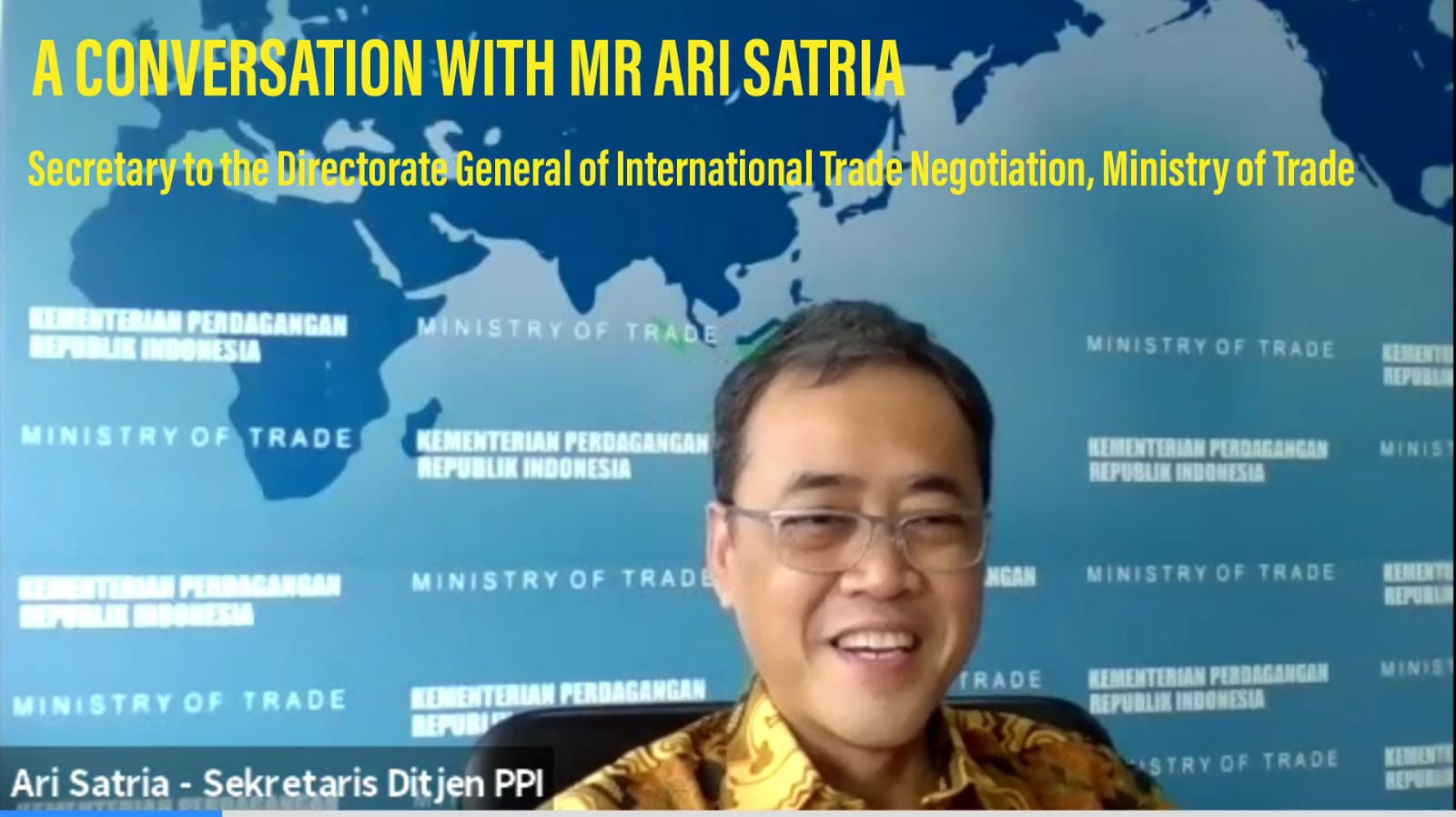
On Thursday, 22 July 2021, Mister Ari Satria, S.E., M.A., who also serves as Technical Advisory Board Coordinator for FTA/CEPA Component of ARISE+ Indonesia, kindly accepted us to share his perspectives on trade negotiation to promote the national interest and welfare of the Indonesian population.
Q: What are the priorities that Indonesia aims to achieve for every FTA/CEPA negotiations, especially for the I-EU CEPA?
A: Ten years ago, Indonesia was a bit behind in conducting bilateral negotiations. At that time, Indonesia's trade agreements were carried out within the framework of ASEAN, for example, ASEAN-Korea, ASEAN-Japan, ASEAN-China, and others. We realised this at the beginning of Mr Jokowi's administration. Compared to Singapore, which has made many bilateral agreements, Indonesia is relatively behind. When we negotiated within the framework of ASEAN, of course, we couldn't promote Indonesia's interests specifically since the negotiations carried the interests of ASEAN countries.
We feel that many of Indonesia's interests have not been covered. For example, although there is an ASEAN-Korea agreement already, we need to have a specific Indonesia-Korea CEPA.
Without intending to override the multilateral and regional aspects, we realise that it is very important to carry out bilateral negotiations to promote Indonesia's interests and vision, especially to open market access for Indonesian export.
We seek input from relevant ministries and businesses to determine which countries to explore for bilateral trade cooperation.
Like in the business process, the Ministry of Trade is referred to as downstream, while the upstream is responsible for providing the products, in this case, the ministries that support the small and medium enterprises (SMEs) producers, such as the Ministry of Industry, Ministry of SMEs, Ministry of Agriculture, etc.
As our position is downstream, we should represent and accommodate the upstream parties' needs and interests. In bilateral trade negotiations, the priority we want to achieve is to open market access and increase the value of Indonesia's trade in the future.
Compared to other ASEAN countries, the value of Indonesia's exports is still relatively low. We know that export is one of the economic growth components, so we must boost it.
Currently, 60% of Indonesia's growth is still supported by domestic consumption. In the future, the role of export should be higher.
In terms of determining partner countries, we will target countries that have complementary products, so we are not competing with each other.
The European Union countries, for example, are producers of products that Indonesia does not produce, while Indonesia has products that are not produced by European Union countries.
There are more than 200 countries in this world, and most of them are still an untapped market, for example, countries in Latin America, countries in West Africa (including members of ECOWAS), Middle East countries, etc.
Of course, the principle of negotiation is based on mutual benefit. So when we sit at the negotiation table, we already have a position paper, and so does our partner countries. There will be requests and offers. Since this is a negotiation, we aim to reach win-win solutions.
Q: What are the issues or subjects discussed during trade negotiations?
A: The issues we negotiate depend on which country we deal with and what type of agreement we choose, whether PTA, FTA, or CEPA. We will conduct a study before the negotiation.
Prior to the negotiation, Indonesia and the partner country carry out preliminary talks to determine the scope of the negotiation. Therefore, our negotiation can be more focused. For example, in the PTA agreement with Pakistan, we only negotiate trade in goods. Pakistan focuses on its mandarin orange and Indonesia with its palm oil. Meanwhile, CEPA has a broader dimension of cooperation, including services, investment, and capacity building, for example the I-EU CEPA that is currently still on-going.
Q: What are the strategies to ensure that Indonesia reaches fair FTA/CEPA?
A: As I said earlier, we translate the word "fair" as win-win solutions. We ask them to open market access, but on the other hand, Indonesia should also be willing to open market access for the products of the partner countries. By the time we sit down at the negotiation table, we already know what we will request and must be ready to make an offer. But of course, we will ensure that we open the market access for products that we need, for example, industrial raw materials, or during this pandemic, health products.
In terms of the I-EU CEPA, as an agricultural country and one of the largest coffee producers in the world, Indonesia offers coffee that is geographically not produced by the European Union countries.
Therefore, we enter into a negotiation with countries that have complementary products for Indonesia to avoid competition with our SMEs. So, when it comes to fairness, it should be both ways, fair for our trade partner and fair for our nation's interests.
Q: Is there any coordination with other ministries to prepare policies for implementing trade agreements in the country?
A: In fact, we do the coordination before conducting negotiations during the preparation of the position paper.
In trade agreements, there is usually a clause that allows us to evaluate the agreement after several years of implementation because sometimes conditions on the ground are different from what is on paper. Partner countries can also do the same.
Following the signing of the agreement, there is still an evaluation process when we can ask for input from the businesses as the main actors for the agreement’s implementation.
Q: How does Indonesia prepare top-notch trade negotiators?
A: At the end of 2020, the Ministry of Trade created a functional position of trade negotiator since Indonesia will have lots of trade negotiations in the future. Our negotiator candidates will go through a series of competency tests to become trade negotiators. We will conduct series of capacity building to prepare our negotiators to be more confident to lead negotiations.
Capacity building is carried out through education and training in collaboration with various parties, including ARISE+ Indonesia. We are grateful that ARISE+ Indonesia has facilitated the Ministry of Trade with several courses, such as Global Value Chain and Trade in Value Added (TiVA) training to strengthen the data analysis to support negotiations.
In addition, before advancing to the negotiations, we make internal preparations and consolidate with various stakeholders to prepare the position paper. Therefore, when we sit at the negotiation table, we are truly ready to carry, protect and secure the interests of the Indonesian state.
Negotiators or analysts from other ministries also join and support our negotiator team to strengthen the negotiations.
We plan the process of regenerating negotiators starting from the recruitment of prospective civil servants. From the beginning, we will allocate the number of persons whom we will teach to become negotiators. We will then develop their competencies.
In the future, we will also open the position of negotiator in other ministries since our colleagues in other ministries participate in the negotiation process.
Q: What are the policies to maximise benefits of the FTA/CEPA implementation, especially to reduce economic inequality within the society?
A: When we only have trade agreements within the ASEAN framework, it turns out that many of our business actors have not taken full advantage of the trade agreement. The utilisation of the trade agreement is still low, which means that there is a lack of promotion actions.
Many business actors do not know how to take advantage of existing trade agreements to increase the competitiveness of their products. Therefore, in the last few years, we have built FTA Centres in several regions to disseminate the negotiation results between Indonesia and trading partner countries.
The visitors of the FTA Centre do not only seek information about the existing trade agreement scheme but also ask about how to get buyers, how are the regulations in the export destination country. Based on that situation and suggestion from Bappenas, we convert one of our FTA Centres in Surabaya into an Export Centre, a one-stop information service for business actors to find information on exports from A to Z and FTAs.
That's one way to increase the utilisation of FTAs. In addition, we also conduct dissemination in every forum about our FTAs to all relevant stakeholders.
The community must know that when we sit at the negotiation table, we are carrying the interests of the Indonesian state. All trade agreements that we sign first go through a long process to ensure that the results are in accordance with our needs.
The imported products that enter our country are products that we need but cannot produce, such as raw materials as input for our manufacturing to improve our economy and the welfare of the Indonesian people.
If we ask other countries to open their markets, we must also open ours. The two-way street relationship also applies in trade.
When I was a trade attaché in Korea back then, the Korean Government celebrated their global trade value reaching more than one trillion USD. The trade value between the export and import is more or less balanced. So if we want to increase the value of our trade, we must go both ways, increasing exports and opening up our imports. Although, we still have to be selective in importing products not to harm the businesses in our country.
We need to assure our society that our negotiators will always put the national interest first in every trade negotiation.
Opening up export markets, increasing investment, fulfilling domestic needs, significantly improving the participation of the Indonesian industry in the Global Value Chain to boost our economy are the things we are fighting for at the negotiation table for our country's interest.