
Strengthening the National Quality Assurance (NQA) and Export Quality Infrastructure (EQI) systems is one of the Government of Indonesia’s efforts to ensure the quality of Indonesian products and their access into international markets. The well-functioning of the NQA and EQI is crucial for increasing the competitiveness of Indonesia's products and enabling the country to upgrade the value-added of exports and to participate in global value chains.
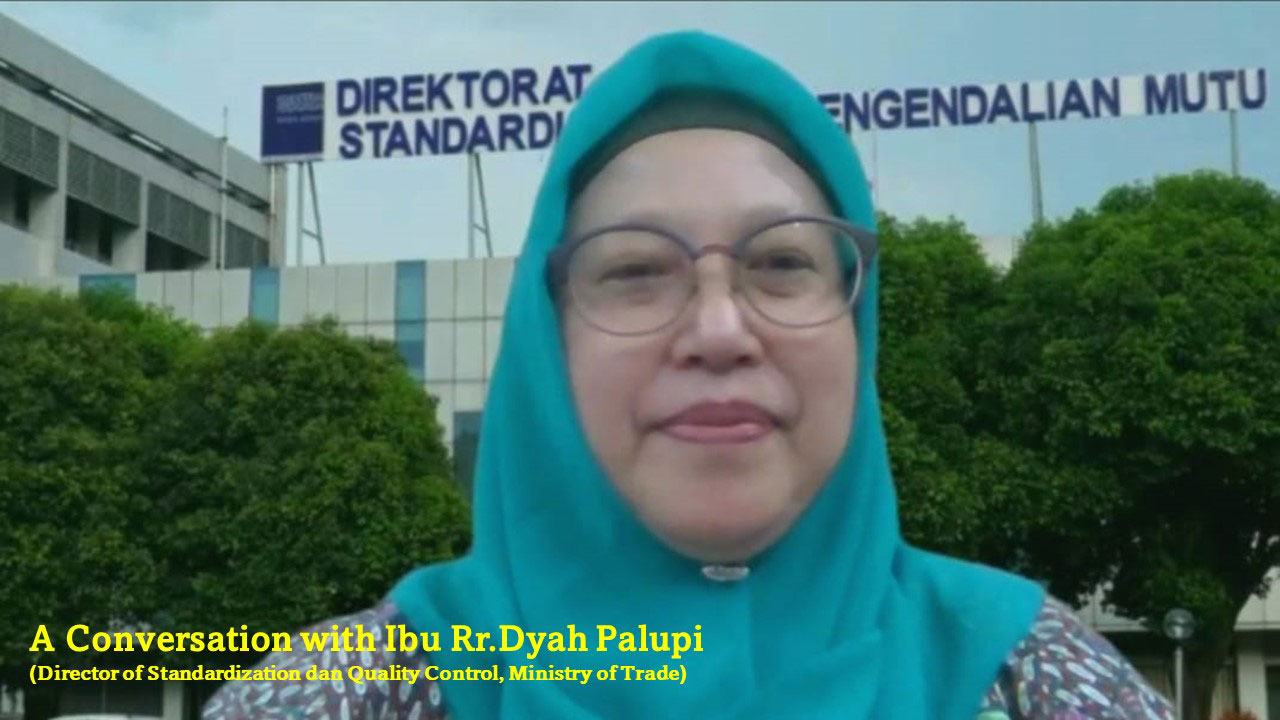
The Director of Standardisation and Quality Control, Madam Rr. Dyah Palupi, has kindly accepted to share with us her perspectives on the development of Indonesia’s NQA and EQI and the Government's plans to enhance them.
Q: In the Government Work Plan 2022, exports are expected to be one of the prime movers for Indonesia's economic recovery. How ready are the National Quality Assurance (NQA) system and Export Quality Infrastructure (EQI) to ensuring the access of Indonesian products, both for food and non-food products, into the international market, especially the European Union market?
A: The National Quality Assurance System is a product safety control system in each value chain that requires integration and coordination between Ministries/Agencies, business actors and Conformity Assessment Agencies. Indonesia’s NQA was developed as part of the technical cooperation between Indonesia and the European Union through the Trade Support Program II (TSP II) launched in 2013 and followed by the ARISE+ Indonesia program.
To support economic recovery, we are ready to enhance our NQA system to ensure compliance with internationally accepted legal, consumer and market requirements. Our NQA system has promoted harmonisation and coordination among stakeholders to ensure product quality in each production value chain of the food and non-food sectors in compliance with market and customer requirements.
The existence of NQA supports economic transformation from a stage of natural resources dependency to a competitive modern manufacturing and high added-value services driven economy to improve the nation's prosperity for the welfare of Indonesian society.
Q: Is the EQI system in Indonesia effective and efficient already to meet national and international requirements?
A: The EQI system in Indonesia is legally effective, but implementation is not yet effective and efficient in meeting national and international requirements. This is one of our challenges. We need to synergise our collaboration among the ministries and agencies and harmonise our programmes.
Q: What about the readiness of testing laboratories for food products in the regions? There was the case when the exporter needed to carry out mycotoxin testing, yet the laboratory was not ready in the regions, so the sample had to be sent to Java for testing. It could increase the risk of contamination. What is the Government's plan, especially your directorate, to address this issue?
A: We continue our efforts to strengthen the Center for Testing and Quality Certification of Goods (BPSMB) in the provinces. Although the management responsibilities of the laboratories are delegated to the regions due to regional autonomy, we continue to provide support in capacity development through technical training. Capacity building is where ARISE+ Indonesia can play an important role as well during the project implementation.
Several training initiatives facilitated by ARISE+ Indonesia has allowed government officials to gain new insights and deepen their knowledge.
We also facilitate equipment renewal and Deconcentration Fund for laboratory improvement. We regularly conduct coordination meetings with the provinces and encourage them to allocate laboratory maintenance, testing, and training budgets. Since the local Government receives economic benefits mostly from their commodities, we hope that they are able to increase the export facilitation measures and ensure the sustainability of the laboratories.
Other than BPSMB, there is the Industrial Research and Standardisation Center (Baristand) managed by the Ministry of Industry and the Fish Quarantine and Inspection Agency under the Ministry of Maritime Affairs and Fisheries.
We appreciate that the regions have started to develop the Conformity Assessment Bodies (LPK), such as testing laboratories, Product Certification Agencies (LSPro), and calibration agencies. So, this is good.
Q: Are there any other challenges Indonesia faced in implementing NQA and EQI systems, primarily to ensure the quality and safety of food and non-food export products in compliance with international standards?
A: Coordination among ministries/agencies is our main challenge at the moment. The upstream-downstream coordination for food products is already seen. In contrast, deeper coordination is needed to equalise perceptions in conducting risk assessments, monitoring product quality before and after entering the market, reporting and managing risks systematically for non-food products to provide easy access for producers/industry in improving the products. We also need to make the information on product safety available to consumers.
We are now taking the initiative to start building INRAPEX, the alert system for non-food products, with technical assistance from ARISE+ Indonesia. The system will enable supervisory agencies to share information about unsafe non-food products on the domestic market and thereby strengthen national market surveillance efforts.
Q: Several ministries and agencies are involved as Technical Regulatory Authorities, and some overlap. Producers, exporters and importers also expressed their wish for simplification. How will the Government address this issue?
A: We seek to simplify the bureaucracy without neglecting compliance with applicable technical regulations. The Government has planned several steps, including:
- Conduct national coordination to integrate activities among sectors in ministries/agencies effectively in a risk-based product control system.
- Conduct systematic actions to implement product control to ensure that all activities in the value chain process, from raw materials, production to markets or consumers, effectively achieve the desired results.
- Coordinate supervision when emergency responses related to threats to consumer health and market access are required, including rejection of product exports.
- Apply technical regulations for all consumer non-food products.
Simplifying overlapping regulations is essential to allow producers/exporters/importers to produce safe and quality products more effectively and systematically. For this reason, the Government needs to synergise in determining systematic actions in the context of implementing the NQA system as mentioned above (point 2).
Currently, the Government, through the Omnibus Law, has made simplifications of regulations to facilitate transactions. To date, the discussion on the Omnibus Law, particularly related to the Job Creation Law, is still being carried out to draft its derivative regulations/guidelines. We hope that in the future, the implementation of regulations will be more effective and efficient.
Q: Does Indonesia have a vision for the future EQI? What still needs to be improved, and what would be the strategies to strengthen Indonesia's EQI? Is there a road map as a guide to achieving it? What is on the top of Government priority in future EQI system development (standards, market monitoring)?
A: Indonesia's vision for future EQI is to become a competent world-class EQI system and solution provider, and EQI's mission is to help manufacturers meet standard compliance requirements in the export market, support stakeholders in increasing exports, and become a catalyst in consumer protection.
Yes, we have a roadmap developed with support from TSP II. Several regulations have shown collaboration and coordination among ministries/agencies according to their duties and functions in guiding business actors to meet the standard and quality requirements.
Our main priority is to develop an integrated EQI system in all aspects of product safety in the entire value chain from raw materials, production, distribution to consumption, including exports, to protect consumer health and increase the competitiveness of domestic products in international trade. We also need to integrate our cross-sectoral coordination among all relevant ministries and agencies to ensure appropriate and prompt responses or actions in dealing with risks and product safety. And the decision is made by consensus.
On the other hand, thanks to ARISE+ Indonesia, we now have the NQA Framework. The framework has become the reference for ministries/agencies in coordinating risk analysis of prioritised products along the value chain and handling emergencies over product safety incidents. We hope that ARISE+ Indonesia will be able to facilitate information dissemination to raise stakeholder's awareness of the NQA system.