Technical Assistance II
The services sector has been steadily growing in Indonesia and accounts for around 60% of Indonesia's GDP (Gross Domestic Product) and contributes to 55% of employment. Therefore, improving the services sector's productivity, efficiency, and competitiveness is crucial. The increase in services is a good sign for the Indonesian economy, as a service-dominated economy is a hallmark of developed countries.
Despite the substantial share of the services sector in economic growth, Indonesia faces barriers to trade in services that hamper the ability of the private sector to trade, both through cross-border trade and through foreign affiliates. Many trade agreements now cover the services sector, including RCEP, ASEAN Trade in Services Agreement, WTO, and the ongoing negotiation of Indonesia-EU CEPA.
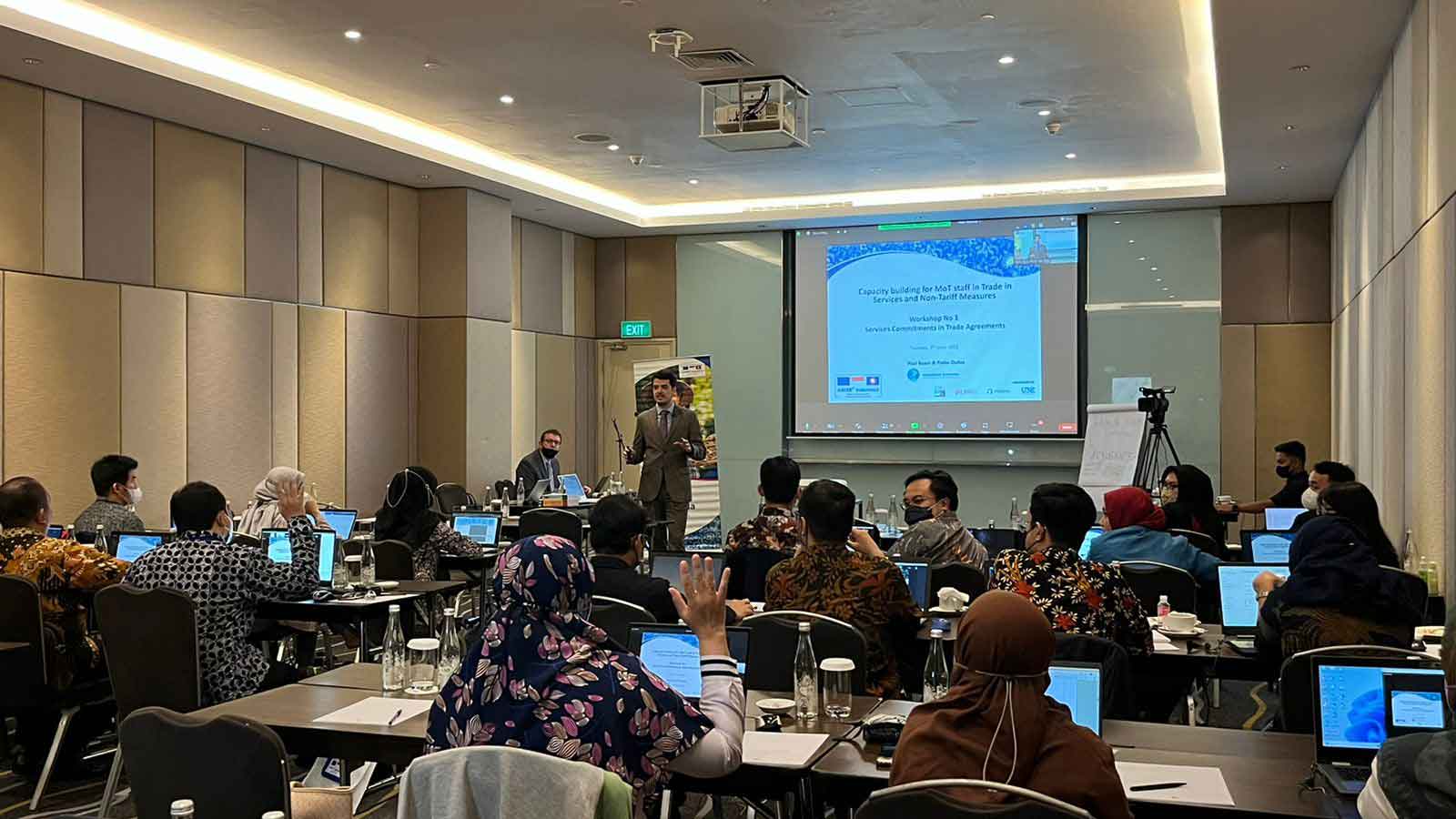
To capacitate the trade analysts and negotiators in evaluating the policies and negotiating the trade in services, the Ministry of Trade, with support from ARISE+ Indonesia, organised a series of workshops.
According to the Director of Trade in Services Negotiation, the Directorate-General of International Trade Negotiation, Basaria Tiara Lumbagaol, the workshop series aims to enhance Indonesia's capacity in Trade in Services negotiations, particularly for the Indonesia-EU CEPA negotiations. An essential part of building capacity is to strengthen the knowledge not just the staff from the Ministry of Trade but also the staff of line ministries critical in formulating trade negotiation position.
Forty officials from the Directorate of Trade in Services Negotiations (DPPJ), Directorate of Multilateral Trade (DPM), Directorate General of International Trade Negotiation (PPI), Directorate of Business Development (Binus PD), Research Center of International Trade Cooperation (Puska KPI) of the Ministry of Trade, the Fiscal Policy Agency (BKF) of the Ministry of Finance, Financial Regulatory Authority (OJK), the Bank of Indonesia, the Ministry of Manpower, the Ministry of Public Works and Housing, the Ministry of Health, and the Ministry of Communication and Information Technology, Agency for The Protection of Indonesian Migrant Workers (BP2MI), and the Indonesian Broadcasting Commission (KPI), participated in the five-day workshop, 6-10 June 2022.
Ms Tiara appreciated the engagement of officials from the ministries in the workshop. "This is a valuable asset and effort in keeping and maintaining good coordination to formulate Indonesia's positions in the negotiation, especially in Trade in Services negotiations," Ms Tiara said in her opening remarks.
The ARISE+ Indonesia Senior Expert in Trade in Services, Paul Baker, and the Trade in Services Lawyer, Pablo Quiles, both of International Economics Consulting Ltd, delivered the workshop in person, joined by the participants in the venue, and a series of keynote guest speakers took part remotely.
The first five-day workshop discussed the basic elements of the General Agreement on Trade in Services (GATS), demystifying trade in services commitments with regard to the ability to reserve domestic policy space and analysing the specific commitments made by the EU and the particular Member States in specific sectors, such as financial services, post and telecoms, maritime transport, and mutual recognition of professional qualifications.
The second workshop took place on 20-24 June 2022 in Bandung, to provide MOT and line ministries officers with an understanding and the skills necessary to analyse and interpret international trade in services data and to evaluate the economic impact from restrictions in Trade in Services.
###