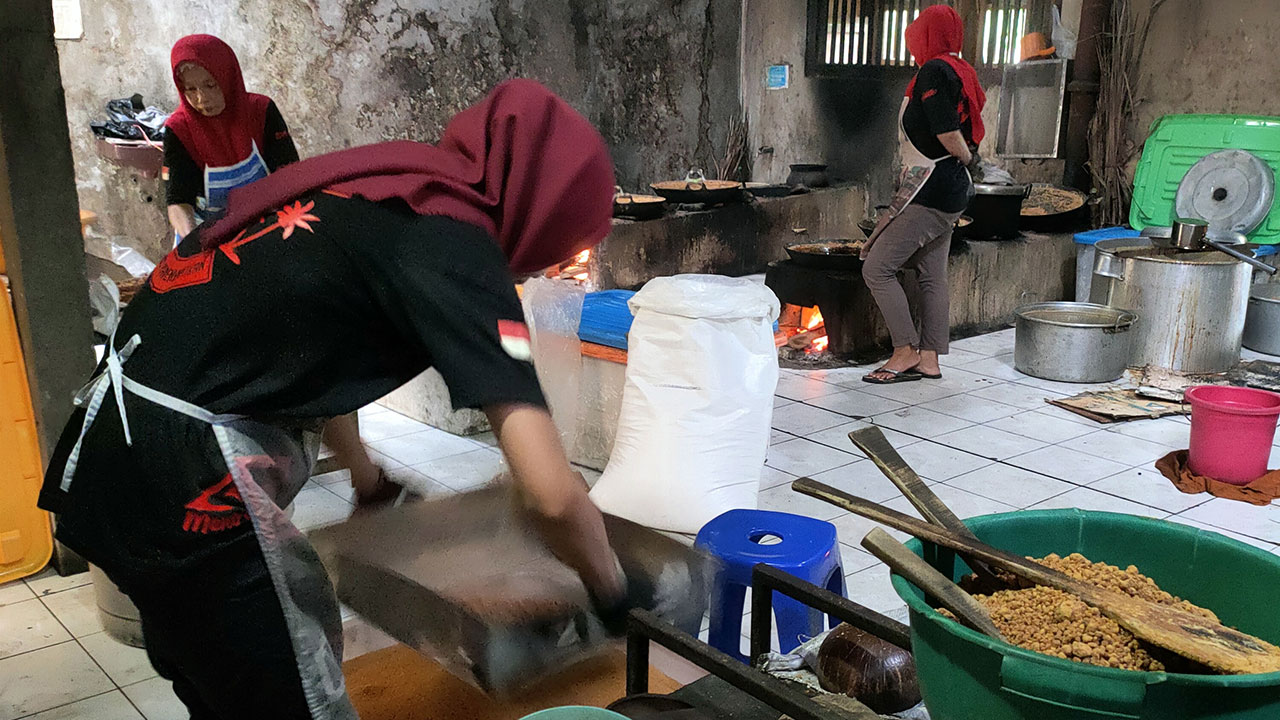
The production of coconut sugar in one of Jogja Kulon Progo Coconut Sugar value chain.
Who has not heard about Darjeeling Tea, Colombian Coffee, Argan Oil, Champagne, Scotch Whisky, Balsamico de Modena (Balsamic Vinegar), Feta (Greek cheese), Gouda Holland (cheese), or Parmigiano Reggiano (Parmesan cheese)? Most of us might have. We recognise those products for their worldwide popularity and reputation. Their renowned quality, unique characteristics, and authenticity are deeply tied to their geographic origins, defined as Geographical Indications (GIs). This association between provenance and quality is denoted terroir (French) that means there is a specific link between the context of production (i.e. climate, soil, culture, tradition, local knowledge) and the quality of the produced product (Parrott et al., 2002), thus, eligible for registration and protection under the intellectual property law. Unlike other intellectual property rights (patents, trademarks, copyrights), GIs are owned collectively by all producers in a region rather than by an individual or a single company.
Today, Indonesia has 100 domestic and eight foreign-registered GI products. Some Indonesian agricultural GI products are also popular globally, such as coconut sugar and many coffee products, including Arabica Gayo Coffee. However, whether Indonesian GI products have gained a reputation for quality and authenticity in the international and domestic markets would be a different question since many of us may not be familiar with the Indonesian protected GIs yet.
The GI concept is relatively new for Indonesia, even after more than two decades since it was first introduced in the Trade-Related Aspects of Intellectual Property Rights (TRIPS) Agreement under the World Trade Organization (WTO) Agreement in 1994. The first Indonesian GI product to be registered was the Bali Kintamani Arabica Coffee in 2008. On the other hand, the European Union has a robust GI system, which is due to several centuries of development and progress. The GI protection in Europe dates back to the 15th century when a French parliament decree regulated Roquefort (blue cheese made out of sheep milk).
Geographical Indication has a great potential in fostering sustainable economic development through competitive advantage and added value derived from the quality and reputation embedded in geographical attributes and resources. The growing consumer interest in product attributes such as origin, sustainability, traceability and authenticity has also created market opportunities for speciality products. Nevertheless, those economic benefits do not come automatically. The reputation of GI products should be built and protected to allow the community to reap maximum economic benefits from the GI certification by providing consumers with an assurance of the quality, authenticity, and traceability of GI products.
As GI is part of the Indonesia-EU Comprehensive Economic Partnership Agreement (CEPA) negotiation, the Government of Indonesia, supported by the EU-funded ARISE+ Indonesia, is geared up to strengthen Indonesian GIs' reputation, aiming to increase exports and domestic market.
The Directorate General of Intellectual Property (DGIP) of the Ministry of Law and Human Rights and the ARISE+ Indonesia visited three selected GI Protection Communities (Masyarakat Perlindungan Indikasi Geografis/MPIG), the GI rights holders of Arabica Gayo Coffee, Bali Amed Salt and Jogja Kulon Progo Coconut Sugar during November-December 2021.The Directorate of Market Development and Export Information, the Directorate General of National Export Development (DGNED) of the Ministry of Trade, joined the visit to Kulon Progo, Jogja.
According to the Section Head of GI Examination, the Directorate of Trademarks and GI, DGIP, Gunawan, the purpose of the visits was to take stock of progress of implementation of GI internal control plans on the ground. Implementing internal control is the first level of control necessary to ensure the authenticity of GI products to the market and final consumers.
"It is important to ensure that the GI products comply with the Book of Specifications," Gunawan said during the meeting with the MPIG of Jogja Kulon Progo Coconut Sugar in Kulon Progo. "The objective is twofold: to provide product quality assurance to consumers, thus, maximise the economic benefit for the GI rights holder community."
The Coordinator of America and Europe Cooperation, at DGNED of the Ministry of Trade (MoT), Singgih Sugiyanto, stated that DGNED was ready to support the promotion and market access of GI products domestically and on export markets. Singgih also reminded the MPIGs to strengthen their organisational capacities and avoid internal conflicts that could cripple the organisation and prevent the community from reaping the economic benefits of the GI certification.
Prior to the field visit, fifteen Internal Auditors from the three selected MPIGs (Arabica Gayo Coffee, Bali Amed Salt and Jogja Kulon Progo Coconut Sugar) took part in the Internal Control Plan Training, held during September-October 2021. Officials from DGIP, MPIG and Cooperative leaders also joined the training.
As a result of the internal control exercise a list of conforming operators was produced. This will be an important basis for external certification which is required to safeguard the reputation of the GI. Solid control is necessary to avoid risks for delivering non-compliant, non-original products.
Internal Control Plans may also be strengthened with the use of an on-line traceability system which allows consumers to track every aspect of the production and distribution of GI products.
According to Hendro Utomo, the Coordinator of Internal Auditor from the MPIG of Jogja Kulon Progo Coconut Sugar, the training was exciting and beneficial, especially the audit techniques and GPS point retrieval. The training has equipped him and his fellow auditors to implement the internal control plan in the future.
"We have completed and submitted the data collection of farmers, collectors and processors along our value chain, including the GPS coordinates," Hendro said.
ARISE+ Indonesia also facilitated the external certification to guarantee the compliance of products with the Book of Specifications (BoS) and to safeguard the reputation of local GI products on export and domestic markets. "Professional and ISO 17056 accredited third-party audit and certification before placing a GI product on the market is necessary to guarantee its integrity and its image as the ambassador of Indonesian culture and heritage," Giovanni Galanti, the ARISE+ Indonesia GI Expert, said.
Consultations with other private sector operators were also conducted during the field visit to build a better understanding of GIs. Aliet Green Ltd., an exporter in the MPIG of Jogja Kulon Progo Coconut Sugar value chain, expressed their commitment and willingness to support the GI reputation building, especially in the international market, by encouraging the use of correct GI labels on the packaging of exported GI products.
The Chair of MPIG Jogja Kulon Progo Coconut Sugar, Suparyono, expressed his hope that the assistance and support from the Government and ARISE+ Indonesia will improve their export performance for the welfare of MPIG members.